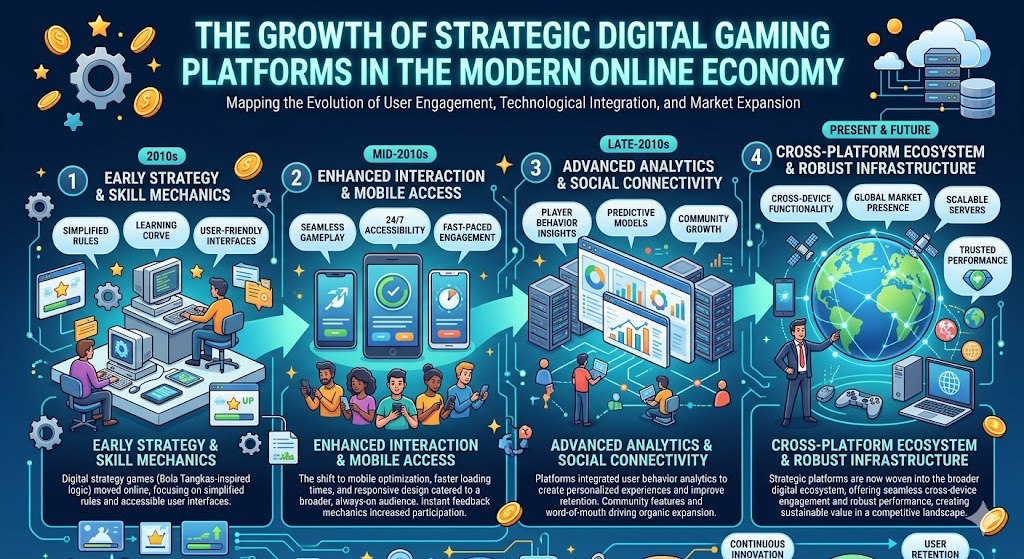
The Growth of Strategic Digital Gaming Platforms in the Modern Online Economy
Introduction
The digital economy continues to evolve at a breathtaking pace, fundamentally reshaping how people interact with technology, entertainment, and online platforms. Among the most significant developments of recent years is the steady rise of strategic digital gaming environments — platforms that fuse traditional gameplay mechanics with modern technological infrastructure to deliver experiences that are as mentally stimulating as they are entertaining.
What sets these platforms apart from conventional gaming formats is their deliberate emphasis on cognitive engagement. Rather than relying purely on high-end graphics or linear storytelling, strategic platforms put decision-making, pattern recognition, and analytical thinking at the center of the experience. This shift is not accidental. It reflects a broader and deeply human desire for meaningful interaction in a digital world that increasingly rewards passive scrolling and short-form consumption.
As technology continues to advance, strategic gaming platforms are carving out a permanent and influential space within the global online ecosystem — one that touches not only entertainment, but also digital culture, user psychology, and the very way we spend our time online.
The Evolution of Online Gaming in the Digital Era
To understand where strategic gaming platforms stand today, it helps to look at how far online gaming has come. A decade ago, the average gaming experience was constrained by slow internet connections, clunky interfaces, and hardware limitations that made real-time interaction a distant dream for most users. The experience was often frustrating, and the barrier to entry was high.
That world has changed dramatically. The widespread rollout of high-speed mobile internet, combined with breakthroughs in cloud computing and real-time data processing, has cleared away nearly all of those obstacles. Today’s platforms are fast, responsive, and designed to perform beautifully across a range of devices — from high-powered desktop computers to budget smartphones.
Modern gaming platforms now routinely offer cross-device compatibility, allowing users to pick up exactly where they left off regardless of what screen they are using. Real-time gameplay interaction has become a standard expectation rather than a luxury. Advanced user interfaces guide players intuitively through complex systems, and secure digital environments give users the confidence to engage without worrying about their personal data. These improvements have made online gaming genuinely accessible to a global audience, erasing the technical and geographic barriers that once limited participation.
The Rise of Strategic Gaming Platforms
Within this broader gaming boom, one of the most interesting trends has been the growing appetite for strategy-based systems. Casual games still have their place, but a growing segment of users is looking for something more — experiences that require them to actively think, adapt, and grow.
Strategic gaming platforms rise to that challenge. They are built around mechanics that demand more than a quick tap or a lucky spin. Probability-based thinking, pattern recognition, and logical reasoning are all part of the experience. Players who engage with these platforms consistently report that the gameplay feels rewarding in a way that more passive entertainment simply does not.
This trend is visible in the increasing interest in formats like tangkasnet online, where structured gameplay rewards careful analysis and precision over luck alone. Similarly, the digital revival of classic formats like bola tangkas online shows that traditional gameplay concepts — when reimagined thoughtfully for modern platforms — can attract entirely new generations of players without losing the characteristics that made them compelling in the first place. There is something genuinely satisfying about a game that carries history and familiarity, yet feels completely at home on a modern device.
Why Strategic Gaming Appeals to Modern Users
The appeal of strategic gaming is, at its core, a human story. In an age of information overload, where the average person is bombarded with notifications, headlines, and content at every moment, the idea of sitting down with a game that actually requires your full attention is surprisingly refreshing.
Mental stimulation is perhaps the most obvious draw. Strategic games ask players to think critically, weigh options, and make decisions with real consequences within the game world. For many people, this kind of focused thinking is a welcome break from the shallow multitasking that defines so much of modern life.
Beyond stimulation, these platforms offer genuine skill development. Unlike games where the outcome is entirely random, strategic platforms give players the tools to improve over time. Someone who has been playing for six months is measurably better than when they started — and that sense of personal growth is deeply motivating.
Flexible gameplay is another major factor. Modern users do not have the luxury of dedicating three-hour blocks to a single activity. Life is busy, and entertainment needs to fit around it. Strategic platforms understand this, offering session structures that can be as short as five minutes or as long as an hour, depending on what the player needs. There is no pressure, no penalty for logging off, no long cutscene that cannot be skipped.
Finally, accessibility has made these platforms viable for a global audience. Mobile-optimized design means that anyone with a smartphone and an internet connection can participate. The playing field is genuinely level in a way that physical gaming never could be.
The Role of Technology in Enhancing User Experience
None of this would be possible without the technological foundation that modern platforms are built on. The best strategic gaming platforms are engineering achievements as much as they are design ones.
At the heart of fair gameplay is the Random Number Generator (RNG) — a system that ensures outcomes are genuinely unpredictable and unbiased. For any platform that involves probability-based mechanics, the integrity of the RNG is non-negotiable. Players need to know that the game is not tilted in anyone’s favor, and a well-implemented RNG is the technical guarantee of that promise.
Real-time processing is equally critical. Nothing breaks immersion or frustrates a player faster than lag. Modern platforms invest heavily in server infrastructure and data optimization to ensure that gameplay feels instantaneous, whether a user is connecting from a fiber-optic broadband line or a 4G mobile network in a developing country.
Mobile optimization goes far beyond simply making a desktop site fit on a smaller screen. True mobile optimization means rethinking the interface from the ground up — touch-friendly controls, simplified navigation, fast load times, and layouts that make sense on a portrait-oriented display. Platforms that get this right see significantly higher engagement and retention.
Underpinning all of this is secure infrastructure. Data breaches and privacy violations are a genuine concern for online users, and gaming platforms are not immune. The most trusted platforms invest seriously in encryption, secure authentication, and transparent data policies. Without this foundation, no amount of great gameplay design can build lasting trust.
The Importance of Platform Reliability and Trust
Trust is perhaps the most underappreciated ingredient in a gaming platform’s long-term success. It is easy to attract a user once with flashy marketing. Keeping them — and earning their genuine loyalty — requires something more substantial.
Reliable platforms demonstrate their trustworthiness through consistent performance. They do not go down unexpectedly. They process transactions accurately and on time. When something does go wrong, their support teams respond promptly and honestly. These might sound like low bars, but in practice they separate genuinely reputable platforms from the countless mediocre ones that crowd the market.
Platforms like mytangkas are frequently associated with this kind of structured, reliable digital environment. Their reputation within the community is built not on aggressive advertising but on a track record of stable performance and fair play. In a crowded market, that kind of trust is genuinely rare and genuinely valuable.
The Integration of Gaming into Daily Digital Life
One of the most telling signs of the maturation of online gaming is how thoroughly it has woven itself into the fabric of everyday life. Gaming is no longer something people do instead of their other activities — it is something they do alongside them.
A quick strategic game during a lunch break. A few rounds on the commute home. An evening session while the TV plays in the background. These patterns are increasingly common, and they reflect a broader shift in how people relate to digital entertainment. The old model — sit down, dedicate your full attention, play for hours — still exists, but it shares space with a much more fluid, integrated approach.
Strategic platforms are particularly well-suited to this lifestyle. Their gameplay loops are designed to be satisfying in short bursts without feeling incomplete. A player can step away after ten minutes and feel that they had a genuine experience, not just the beginning of one.
Economic Impact of Online Gaming Platforms
The economic footprint of online gaming is substantial and still growing. These platforms generate significant revenue through multiple channels — subscription models, in-platform services, digital marketplaces, and advertising — and their growth has a ripple effect across adjacent industries.
Content creators have found fertile ground in gaming platforms, building audiences around tutorials, strategy guides, and live gameplay. Platform developers and software engineers are in high demand. Digital marketers have developed entire specializations around gaming audience engagement. The ecosystem is rich and self-reinforcing.
Beyond direct employment, gaming platforms contribute to the broader digital economy by driving demand for infrastructure — cloud services, cybersecurity, payment processing, and mobile hardware all benefit from the sector’s growth. It is, in many ways, a quiet but significant engine of the modern tech economy.
The Role of Community and Social Interaction
Gaming has always been, at some level, a social activity. Even the earliest video games inspired conversations, rivalries, and shared experiences. Digital platforms have taken this social dimension and amplified it enormously.
Today’s strategic gaming environments offer live chat systems, global leaderboards, and multiplayer modes that connect players across continents in real time. These features transform what might otherwise be a solitary experience into something genuinely communal. Players share strategies, celebrate wins, commiserate over losses, and build relationships that sometimes extend well beyond the platform itself.
This sense of community is not just a nice feature — it is a powerful driver of retention. People return to platforms where they feel connected and recognized. The social layer gives users a reason to come back even on days when they might not feel like playing, simply to check in with others who share their interest.
Challenges Facing the Industry
For all its momentum, the online gaming industry is not without its difficulties. Regulatory complexity is perhaps the most persistent challenge. Gaming platforms operate across dozens of jurisdictions, each with its own rules around licensing, data privacy, taxation, and acceptable game mechanics. Navigating this landscape requires significant legal expertise and constant vigilance as regulations continue to evolve.
Cybersecurity is another ongoing concern. As platforms grow in scale and handle increasingly large volumes of user data and financial transactions, they become more attractive targets for bad actors. The most responsible platforms treat security as a continuous investment rather than a one-time implementation.
Market competition is fierce. The low barrier to entry in software development means that new platforms launch regularly, and users have no shortage of options. Standing out requires not just good technology but genuine commitment to quality, fairness, and user experience over the long term.
The Future of Strategic Digital Gaming
Looking ahead, the trajectory for strategic gaming platforms is genuinely exciting. Artificial intelligence is beginning to play a meaningful role in personalizing gameplay — adapting difficulty levels, suggesting strategies, and tailoring the experience to individual players in ways that were not possible even a few years ago. Cloud gaming infrastructure is removing the last remaining hardware barriers, meaning that increasingly sophisticated experiences will be available to anyone, anywhere.
The integration of more immersive digital environments, improved system responsiveness, and smarter matchmaking systems will continue to raise the ceiling of what these platforms can offer. The core appeal — cognitive engagement, fair competition, accessible design — is unlikely to change, but the expression of that appeal will keep evolving.
Conclusion
The rise of strategic digital gaming platforms is one of the more quietly significant stories in the modern digital economy. By combining the timeless appeal of gameplay that rewards thinking and skill with the accessibility and convenience of modern technology, these platforms have built something with real staying power.
The growing interest in formats like tangkasnet online and bola tangkas online is not a niche trend — it reflects a broad and genuine human desire for digital experiences that ask something of us in return. Platforms like mytangkas are part of that story, offering users the stable, fair, and engaging environments they have come to expect.
In an increasingly connected world, where the line between digital life and everyday life continues to blur, strategic gaming platforms are not simply a leisure activity. They are a reflection of how technology shapes human behavior, how communities form around shared experiences, and how the best digital products earn trust not through spectacle, but through consistency, integrity, and genuine respect for the people who use them.