How Do I Conduct an OT Security Risk Assessment?
A control system that stops for an hour can mean a halted production line, a water treatment plant running blind, or a safety incident. That is why an OT security risk assessment is not a copy of the IT version with different labels. It has to weigh cyber exposure against physical consequences, uptime, and safety, and it has to be done without disturbing the processes it is meant to protect.
This guide walks through a practical, six-step approach that plant owners, security teams and engineers can adapt to their own environment.
Why OT Risk Assessment Differs From IT
In IT, confidentiality usually leads the priority list. In operational technology, availability and safety come first. Programmable logic controllers, SCADA servers and other industrial devices often stay in service for many years, run firmware that cannot be patched quickly, and were designed long before they were connected to corporate networks.
Two consequences follow. Active scanning techniques that are routine on an office network can crash fragile industrial devices, so assessments lean on passive monitoring and careful scheduling. And risk is scored by what an attacker could do to a physical process, not only by what data they could steal.
Step 1: Define Scope and Build an Asset Inventory
Start by deciding exactly which systems are in scope. Industrial standards call this the system under consideration: a plant, a production line, a substation or a group of control loops, along with the access points that touch it.
Then list every asset inside that boundary: controllers, human-machine interfaces, engineering workstations, historians, network switches, remote access gateways and the vendor-managed devices that tend to be forgotten. Record each asset’s function, firmware version, location and owner. An assessment can only be as accurate as this inventory, and most teams find devices they did not know were connected.
Step 2: Map the Network and Its Connections
Next, document how those assets talk to each other and to the outside world. Capture the paths between the plant floor and the business network, any internet-facing services, vendor remote access, wireless links and removable-media habits. A current network map, ideally organized around the levels of the Purdue Model, is the foundation of OT security risk assessment best practices, because exposure cannot be scored on connections nobody has seen.
Pay particular attention to the boundary between IT and OT. Flat networks, shared credentials and undocumented remote access routes are the findings that most often change the risk ranking later.
Step 3: Identify Threats and Vulnerabilities
With the map in hand, work out who or what could harm each part of the system and how. NIST SP 800-82 Revision 3 is a useful reference here: it gives an overview of typical OT topologies, identifies common threats and vulnerabilities, and recommends safeguards to manage the associated risks.
For each asset or zone, note realistic threat scenarios such as ransomware spreading from the business network, misuse of a remote access account, a compromised vendor laptop or an unpatched controller reachable from a neighboring segment. Combine that with vulnerability data from vendor advisories, passive traffic analysis and configuration reviews.
Step 4: Group Assets Into Zones and Rate the Risk
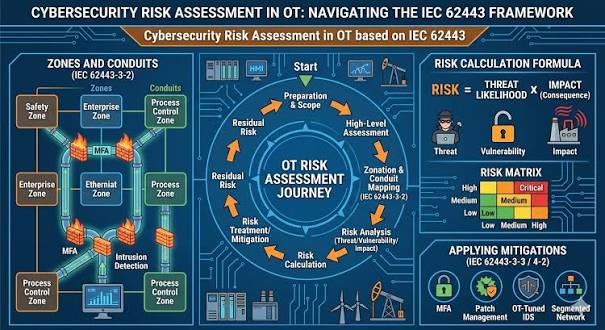
Risk is easier to reason about when assets with similar functions and criticality are grouped. The ISA/IEC 62443-3-2 workflow is built around that idea. It starts with an initial assessment that assumes an attack succeeds and measures the consequences, partitions the system into zones and conduits, and then compares the unmitigated risk with the organization’s tolerable risk to decide where a detailed assessment is warranted.
In practice, score each scenario on likelihood and consequence, including safety, environmental, operational and financial impact. A scenario that is unlikely but could injure people deserves more attention than a likely one that causes a short, recoverable interruption.
Step 5: Prioritize Mitigations Around Operations
Rank the findings, then choose controls that reduce the highest risks without breaking production. Typical priorities include segmenting IT from OT, tightening and monitoring remote access, enforcing least-privilege accounts, and adding monitoring that can detect unusual behavior on industrial protocols.
CISA publishes ICS recommended practices covering defense-in-depth strategies, remote access configuration, patch management and incident response for control systems, which can help turn findings into concrete work items. Where a device cannot be patched, plan compensating controls such as isolation or stricter network rules, and schedule changes for planned maintenance windows.
Step 6: Document, Monitor and Reassess
Record the scope, assumptions, scoring method, findings, owners and target dates in a report that engineering, operations and security leaders can all read. Then treat it as a living record. New equipment, a changed vendor connection or a plant expansion can shift the risk picture, so reassess after significant changes and on a regular schedule, and track whether each mitigation actually reduced the risk it targeted.
Final Thoughts
A useful OT security risk assessment is repeatable, grounded in an accurate inventory, and honest about physical consequences. Start with one site or process, learn which parts of the method work in your environment, and extend the approach from there. Each cycle should leave you with a clearer map, a shorter list of high risks and a plan operations teams can accept.