Roulette Odds and Payouts: The Complete Cheat Sheet


At most roulette tables, the largest number is printed in plain sight: 35:1. It tells you what a straight-up bet pays and almost nothing about what that bet costs over time. For that, you have to count the number of the green pockets.
Roulette odds are less mysterious than the betting layout makes them look. There are only a handful of standard wagers, and most share the same built-in house edge. The exceptions are where players can end up paying more than necessary.
Start by Counting the Zeros
The easiest way to tell European and American roulette apart is to look at the green pockets. European roulette has just one zero alongside numbers 1 through 36. American roulette adds another, marked 00, but keeps the same standard payouts.
It’s a small detail that’s easy to miss, especially when online tables look almost identical. The comparison on Roulette77 can help you spot the differences when browsing games under online roulette real money US. Still, it’s worth opening the game rules to check exactly which wheel you’re getting.
That extra zero makes quite a difference to your chances. European roulette gives the house a 2.70% edge, while the American version pushes it to 5.26%. Sometimes roulette tables even have three zeros, so the edge is brought up to 7.69% with standard payouts, no matter which numbers you pick.
What the Standard Bets Actually Pay
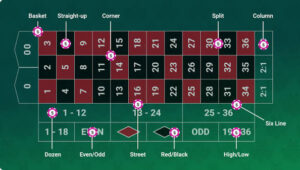
Roulette’s menu looks larger than it is. Every ordinary bet covers a particular number of pockets, and simultaneously the payout shrinks as that coverage grows:
| Bet | Pockets | Net payout | European win chance | American win chance |
| Straight-up | 1 | 35:1 | 2.70% | 2.63% |
| Split | 2 | 17:1 | 5.41% | 5.26% |
| Street | 3 | 11:1 | 8.11% | 7.89% |
| Corner | 4 | 8:1 | 10.81% | 10.53% |
| Six line | 6 | 5:1 | 16.22% | 15.79% |
| Dozen or column | 12 | 2:1 | 32.43% | 31.58% |
| Red/black, odd/even, high/low | 18 | 1:1 | 48.65% | 47.37% |
| American five-number basket | 5 | 6:1 | Not offered | 13.16% |
“Net payout” means profit before your original stake is returned. A $10 straight-up winner earns $350 and gives you the $10 back. A winning $10 red bet returns $20 in total, though it hits much more frequently.
The Missing Dollar
Say you put $10 on number 17. The ball lands there, and you’ve just made $350. Nice result, until you realize that a mathematically fair payout would have earned you $360. The casino keeps that extra $10 out of the equation.
Now try betting on red. You’ve got 18 numbers working for you, which sounds pretty close to a coin toss. Except there are 19 ways to lose on a European wheel, thanks to that green zero. It doesn’t seem like much on one spin, but keep playing and that tiny difference starts to matter.
The American Basket Bet
If you are playing American roulette, the five number basket might catch your attention. It covers pockets with numbers 0, 00, 1, 2, and 3, giving you several chances to hit something. Sounds reasonable, especially compared with putting everything on a single number.
But look at what you are actually getting. A $20 basket bet earns $120 in profit when it wins, yet your chance of hitting is just 13.16%. The house edge works out to 7.89%, compared with 5.26% for most other standard American bets.
The problem isn’t the number of pockets you’re covering – it is that the casino pays less than those five pockets are worth. Roulette 77 breaks down these payout differences in its educational guides, which can be useful when you’re exploring unfamiliar bets.
To put the numbers into perspective, imagine making $1,000 worth of wagers over several sessions. On a European wheel, your average loss in theory would be $27, compared with $52.60 on a standard American wheel. Put that entire $1,000 through the American basket bet, and the expected loss climbs to about $78.95.
French Roulette Has a Rule Worth Knowing About
French roulette gets less attention than its American cousin, which is a shame because some tables offer better conditions. One rule in particular, called la partage, can make a noticeable difference to your losses.
Imagine you’ve put $20 on red, and the ball drops into zero. Normally, that would mean losing the entire $20. With la partage, the dealer returns $10 – meaning you only lose half your bet.
It might not sound particularly exciting, but the mathematics improves considerably. The house edge on eligible even money bets drops to 1.35%. Over a longer playing session, keeping half your stake when zero appears can make a meaningful difference.
There’s another French rule called en prison,; instead of returning half your stake, the casino holds your even-money bet for another spin. Depending on the outcome, you may recover your original stake or lose it, with repeated zeros handled according to house rules.
However, one detail is easy to overlook: these benefits generally apply only to even-money bets. Betting on individual numbers or dozens won’t usually qualify, regardless of which French rule the table offers.
Also, don’t assume every game labeled “French Roulette” includes either rule. Some simply use a single zero wheel and a French-style betting layout. Check the rules before playing.
Why the History Board Changes Nothing
After seven consecutive blacks, red can look overdue. The feeling is understandable, but the mathematics of probability shows why independent spins do not compensate for earlier results. On a fair European wheel, red remains an 18-in-37 proposition on the next spin.
This is also where the Martingale system gets its appeal. Doubling a $10 wager after each loss requires $20, then $40, $80, $160, and $320. Six losses consume $630, and the next stake would be $640.
A win can recover those earlier losses, but a losing sequence can outlast a bankroll or hit a table limit.
What the Numbers Are Good For
Knowing the odds won’t help you guess the next winning number, but it can save you from a bad deal. Why play a double-zero wheel when a single-zero version gives you better odds? And if you find a French table with la partage, even better.
You can’t outsmart the wheel, but you can be a little pickier about where you put your money. That’s already worth something.