Non-Custodial Crypto Swaps: How to Exchange BTC, ETH and USDT in Minutes
Moving capital across Bitcoin (BTC), Ethereum (ETH), and Tether (USDT) appears straightforward until you calculate the total lifecycle cost of the transaction. Between multi-block deposit confirmations, hidden spreads embedded inside instant quotes, dual-network gas fees, and the counterparty exposure of leaving funds on a centralized balance sheet, standard routing quickly erodes profitability.
Adopting non-custodial crypto swaps eliminates centralized custody risk, while algorithmic liquidity aggregation minimizes price impact and spread overhead. This technical guide evaluates the primary execution architectures for direct BTC to ETH swaps or USDT settlements, breaking down the exact mechanics that determine whether a cross-chain order settles cleanly.
Non-Custodial Crypto Swaps vs. Custodial Exchanges: Execution & Counterparty Risk
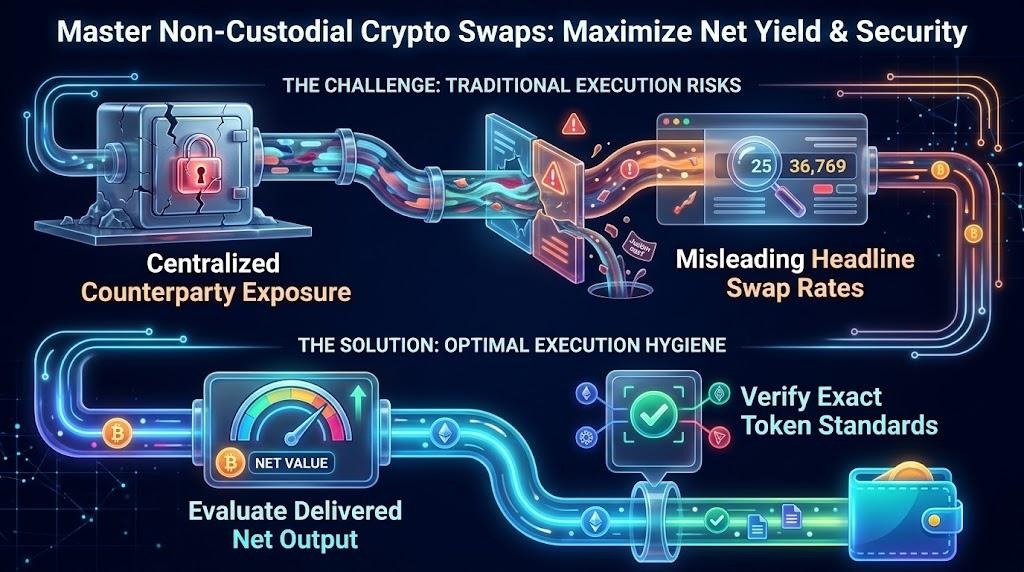
Centralized exchanges (CEXs) require a dual trust assumption: you trust the platform to maintain solvency while holding your deposited balance, and you trust its internal compliance engine to approve your withdrawal request when you exit to cold storage. Non-custodial settlement eliminates the balance-sheet exposure entirely. You transmit assets from your self-custody wallet to a single-use deposit address tied to a specific order, and the converted output settles directly into your destination wallet. There are no standing account balances, no arbitrary withdrawal queues, and zero exposure to exchange insolvency.
However, removing custody does not make a transaction strictly trustless. During the settlement window, you still rely on the underlying liquidity provider to honor the quoted rate. Consequently, counterparty risk shifts from custody to execution quality, specifically, the delta between the initial quote and the final fill.
On floating-rate orders, this manifests as market slippage during block confirmations; on fixed-rate orders, it is reflected in the protective spread buffer baked into the quote. Furthermore, on-chain network mismatches remain irreversible, and certain liquidity providers enforce automated AML screening that can temporarily pause settlement. Because execution quality is quantifiable, experienced operators can systematically measure and mitigate it prior to routing funds.
Crypto Swap Aggregators: Evaluating True Net Output Over Headline Rates
Instant-swap quotes rarely reflect raw mid-market spot prices. Because individual liquidity providers embed their operational fees and volatility buffers directly into the exchange rate, evaluating a trade based on the headline rate field is misleading. The only metric that dictates net profitability is the final delivered amount settling in your receiving wallet.
Crypto swap aggregators streamline this analysis by querying dozens of liquidity venues simultaneously, displaying both fixed and floating rate structures side by side. Advanced aggregation engines go beyond static price discovery by tracking post-trade execution telemetry: average payout latency, order failure rates, and the historical variance between quoted and delivered outputs. Crucially, modern routing layers also grade providers on compliance friction, highlighting routes with “No Hold” histories or transparent KYC thresholds so traders can actively avoid bait-and-switch pools that freeze funds post-deposit. When two quotes sit within a fraction of a percent, execution reliability and zero-hold guarantees should always dictate the route.
How to Swap BTC, ETH, and USDT: 4 Execution Routes Compared
No single execution architecture dominates every trading scenario. Selecting the optimal path depends on transaction volume, your tolerance for identity verification, and the specific blockchain network hosting your target USDT.
| Execution Architecture | Custody & Verification | Cost Structure & Optimal Fit |
|---|---|---|
| Centralized Exchange (CEX) | Custodial balance sheet; mandatory KYC and AML checks | Maker/taker fees plus flat withdrawal fees. Best for fiat ramps where privacy is not a priority |
| Decentralized Exchange (DEX) | Self-custody via wallet; smart-contract approval risk | On-chain gas, pool price impact, and MEV. Optimal for same-chain (e.g., ERC-20) pairs; requires wrapping for BTC |
| Non-Custodial Instant Exchange | Non-custodial settlement via single-use deposit address; no account required | Single provider’s embedded spread plus network fees. Best for quick swaps when sticking to one known provider |
| Swap Aggregator (Web UI or MCP Server) | Non-custodial settlement; zero accounts, and no API key needed via MCP | Zero added aggregator commission; captures the lowest embedded spread across 15+ providers plus network fees. Best for comparing fixed/floating quotes in a browser or automating swaps via AI agents (MCP) |
When calculating total cost, explicit commission percentages rarely tell the full story; spread markups, pool depth, and two-way network gas fees dictate the final yield. For Bitcoin operators in particular, routing through a traditional DEX requires synthetic wrapping or third-party bridges, which is why most sovereign traders favor native cross-chain swap aggregators. An MCP server is simply another way to reach the same aggregator: the route and the cost stay identical, and only the interface changes.
Native Cross-Chain Routing: Direct BTC to ETH Swaps vs. Multi-Hop Routing
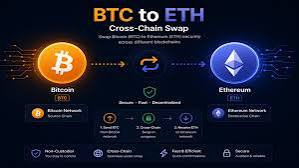
Because Bitcoin and Ethereum represent the deepest liquidity pools in the market, major centralized exchanges offer direct BTC/ETH spot books without requiring a stablecoin hop. However, executing that trade on a CEX still forces a three-step custodial workflow: waiting through multi-block BTC deposit confirmations, paying spot trading fees, and absorbing flat withdrawal fees to move native ETH back to cold storage. Meanwhile, executing a BTC-to-ETH swap on a traditional DEX requires synthetic wrapping (such as wBTC) or third-party smart-contract bridges. Routing a direct BTC to ETH swap through a non-custodial aggregator condenses this entire workflow into a single wallet-to-wallet settlement across native chains.
The cost of multi-hop detours becomes even more pronounced on long-tail or privacy-focused pairs. A cross-chain conversion such as XMR to TRX rarely has a direct order book on centralized platforms, forcing traders to sell into an intermediary like USDT on one leg and repurchase the target asset on a second leg. That two-step detour compounds execution friction: you absorb two separate spread markups, pay multiple network gas fees, and wait through two confirmation cycles.
Aggregators and instant exchanges eliminate this double-hop penalty by quoting direct cross-chain liquidity for both major pairs (like BTC to ETH) and long-tail routes (like XMR to TRX), settling the transaction in a single hop with one consolidated spread. Routing through USDT remains justifiable only in specific tactical scenarios: when you intend to park capital in stablecoins between market rotations, when direct pair depth is unusually thin for your order size, or when you are splitting a large block trade across intervals. Always benchmark both paths using identical input volumes before broadcasting a transaction.
Cross-Chain Swap Execution Checklist: Slippage, Rate Windows, and Network Standards
To ensure cross-chain transactions settle without friction, apply five operational rules before sending funds:
- Verify the Exact Token Standard: USDT circulates across multiple incompatible networks—including ERC-20 (Ethereum), TRC-20 (Tron), Arbitrum, and Solana. Confirm that your destination wallet natively supports the exact network selected in your swap order.
- Manage the Fixed-Rate Confirmation Window: Fixed-rate quotes lock in your output against market volatility, but they operate on strict countdown timers. If a Bitcoin transaction is broadcast with a low miner fee and confirmed after the timer expires, the order may recalculate or halt. Use fixed rates for larger volumes where slippage is costly, and prioritize adequate network priority fees.
- Audit Minimum Thresholds and Memo Tags: Verify minimum deposit limits prior to sending, include required Memo or Destination Tags for specific networks, and transmit the exact numerical amount specified in the quote.
- Scale Into Thin Liquidity: When utilizing a new liquidity provider or moving substantial size, validate the route with a micro-transaction first and split oversized orders to minimize price impact.
- Log Settlement Telemetry: Retain your unique Order ID alongside the on-chain deposit transaction hash (TXID) for automated tracking or support reconciliation.
Automated No-KYC Crypto Swaps: MCP Servers for AI Agents
Cross-chain price discovery no longer requires manual browser navigation. Integrating an MCP server for AI agents, such as the Flashift MCP, equips developer environments and AI assistants like Claude Desktop, Cursor, or LangChain to query live liquidity across many providers and over 100 blockchains, compare fixed and floating rates, and generate swap orders with zero accounts and no API keys.
Built on the open Model Context Protocol standard, this architecture allows an operator to issue a natural-language command, such as “Compare native BTC to USDT (TRC-20) quotes for 0.25 BTC and select the lowest KYC route”, and receive real-time rate comparisons, a single-use deposit address, and an active Order ID inside a single chat interface. Because the AI agent never accesses your private keys and the deposit is broadcast directly from your hardware or software wallet, you gain full algorithmic automation while keeping the non-custodial security model 100% intact.
To maximize your net output on every cross-chain transaction, shift your focus from advertised fee tiers to verifiable execution quality. Benchmark routes using identical input sizes, evaluate the final delivered token amount rather than headline rates, double-check network standards, and treat provider reliability as a core component of your pricing model. Executed with proper operational hygiene, native BTC, ETH, and USDT swaps settle directly into cold storage in minutes without ever surrendering custody of your keys.