4 Blackjack Variations and How Their Rules Change the Game
Blackjack might seem straightforward at first. The aim is simple: players aim to finish closer to 21 than the dealer without going over, using familiar decisions such as hitting and standing. However, the rules can change considerably depending on which version is being offered.
Some variations change how the dealer receives cards, while others use different decks, offer additional player choices, or introduce unusual payout conditions. These differences affect how individual hands unfold and which decisions deserve attention. Understanding four popular blackjack variations provides a useful starting point for comparing their rules before playing.
1. Classic Blackjack: The Rules That Set the Foundation
Classic blackjack establishes the familiar structure found across most variations. Players receive two cards and compete against the dealer, aiming for a higher total without exceeding 21. Numbered cards retain their face values, picture cards count as ten, and aces can represent either one or eleven.
The main decisions involve hitting for another card or standing with the current total. Depending on the rules, players can also double down by increasing their wager in exchange for one additional card. Splitting allows eligible pairs to become separate hands, each played with its own wager.
These decisions provide a useful reference point when comparing different versions. Players exploring blackjack at FanDuel Casino can review the available titles and their individual rules to see how each format handles familiar actions. Checking these details helps identify differences before selecting a game.
Even traditional blackjack has important rule variations. Some dealers must stand on a soft 17, while others draw another card. A natural blackjack might pay 3:2 or 6:5, depending on the table. These conditions affect the game’s mathematical characteristics, making the posted rules more informative than the familiar name alone.
2. European Blackjack: A Different Approach to the Dealer’s Hand
European blackjack generally follows the same objective as classic blackjack, but the dealing procedure introduces an important difference. In the common no-hole-card format, the dealer initially receives only one face-up card. The second card isn’t dealt until players have completed their decisions.
This changes when players discover whether the dealer has a natural blackjack. Consider a dealer showing an ace while a player holds eleven. The player might choose to double down without knowing whether the dealer’s eventual second card will complete a blackjack.
The treatment of additional wagers becomes particularly important here. At some tables, a dealer blackjack can cause players to lose money committed through doubling or splitting. Other versions protect those additional amounts and collect only the original wager. Both arrangements exist, making it important to review the table’s specific rules.
European blackjack demonstrates how a small procedural change can influence the financial consequences of a hand. The basic decisions remain recognizable, but the delayed dealer card introduces uncertainty around certain wagers. Players familiar with classic blackjack need to account for this difference rather than assume the same rules apply.
3. Spanish 21: A Different Deck and More Playing Options
Spanish 21 changes the composition of the deck before play even begins. Instead of standard 52-card decks, it uses 48-card decks with the four numbered tens removed. Jacks, queens, and kings remain, so ten-point cards are still available. However, their reduced proportion changes the combinations players are likely to receive during a round.
Removing the numbered tens affects the mathematical characteristics of the game, including the frequency of certain hands. Spanish 21 introduces additional player-friendly rules to compensate for this difference. These can include more flexible doubling options and special payouts, although the precise conditions depend on the version being played.
One distinctive rule concerns hands totaling 21. In common Spanish 21 versions, a player’s 21 wins even when the dealer also reaches that total. Certain combinations qualify for additional payouts, including five-card hands totaling 21 and sequences such as 6-7-8. These rewards make the exact cards forming a winning total relevant, rather than the final number alone.
Players can also encounter options beyond those found in standard blackjack, such as doubling after taking additional cards or surrendering after doubling under specified conditions. This creates more possible decisions throughout a hand, especially when several cards have already been dealt. Still, additional options don’t automatically produce better overall returns, since the altered deck and payout structure must be considered together.
4. Blackjack Switch: Two Hands With an Extra Decision
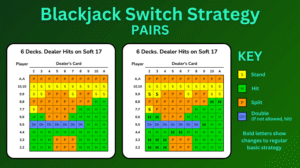
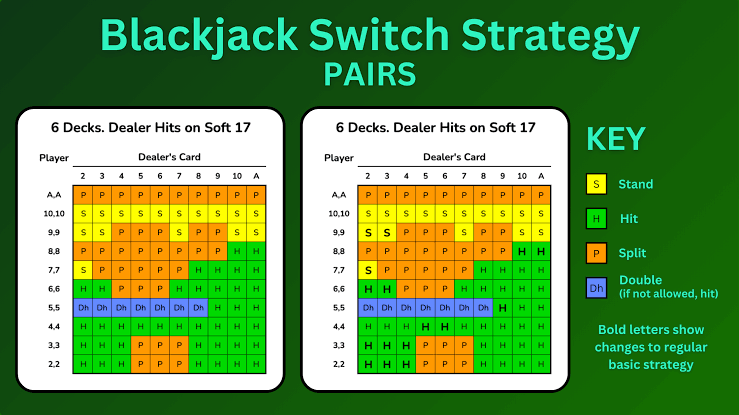
Blackjack Switch changes the opening of a round by requiring players to begin with two hands instead of one. Each hand receives two cards, and the player places an equal initial wager on both. Before normal play begins, players have the option to switch the second cards between their two hands.
Imagine receiving a five and a ten in one hand, alongside a ten and a six in the other. Switching the second cards creates totals of eleven and twenty. This additional decision allows players to rearrange their starting combinations before choosing whether to hit, stand, or double down.
That flexibility comes with different payout conditions. In common Blackjack Switch rules, a dealer total of 22 produces a push against non-busted hands rather than counting as an ordinary dealer bust. An original, unswitched natural blackjack generally remains an exception and wins against that total.
Natural blackjack payouts also differ from many traditional tables. Winning blackjacks commonly pay even money instead of 3:2, while a blackjack created through switching is treated as an ordinary 21. These trade-offs are central to the variation, showing why the ability to exchange cards shouldn’t be evaluated in isolation.
Choosing a Variation Starts With Understanding the Rules
Each blackjack variation changes something meaningful. Classic blackjack provides the familiar foundation, European blackjack alters the dealer’s dealing procedure, Spanish 21 introduces a different deck and additional options, and Blackjack Switch changes how starting hands can be arranged.
Before playing, compare the available actions, dealer requirements, and payout conditions. A variation with more choices isn’t necessarily more favorable to the player, and familiar rules can have important exceptions. Understanding those details makes it easier to recognize what each version offers and how player decisions differ.